


News & Updates
Why Swedish Lapland Belongs on Every Fly Angler’s Bucket List
20
Nov
Nov
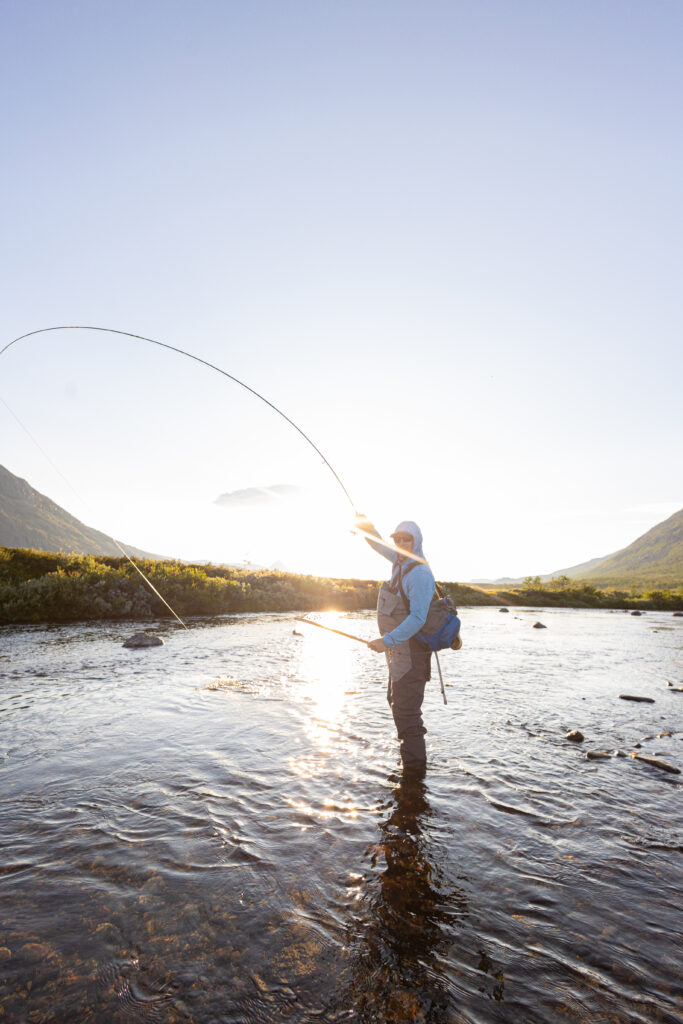
My # 14 Parachute Adams floats tranquilly along, the white hackles catching a bit of golden sunlight from the midnight sun. Suddenly a swirl appears and the fly disappears. The line goes taught and I am rewarded with a flash of reddish-orange as the Arctic char rolls and shows off its brilliantly colored belly as it fights to release itself. It is just before midnight at 67 degrees North, above the Arctic circle in the vast wilderness of Swedish Lapland.
Casting flies above the Arctic Circle in July-Photo Credit: Devon Gulick
We are fishing in the Swedish municipality of Jokkmokk, which is the size of New Jersey but has less than 5,000 inhabitants. Some of the rivers we will fish will not see another angler all year. The water is so clean and pure you can drink straight from the rivers. Strong coffee, cooked over the fire, and with a light taste of smoke, is consumed at all hours. Reindeer browse the lichens in the high mountains with their new calves. The days are so long you can fish around the clock and the fish are brilliantly colored.
But why should a fishing trip to Swedish Lapland be on every fly angler’s bucket list? I think it boils down to 5 things, which, when combined, make for a unique and amazing experience. Those 5 things are the large populations of aggressively feeding wild fish, twenty-four hour daylight and the advantages it affords, saunas, remoteness, and the food.
The large, wild populations of Arctic Char (Salvelinus alpinus), Brown Trout (Salmo trutta), Grayling (Thymallus Thymallus), and huge Northern Pike (Esox lucius) are feeding aggressively to take advantage of the short summer. Often, we can catch many fish in a row from the same spot, as their drive to feed overrides their fear of being caught. The Grayling are beautiful fish with a large, sail-like, multicolored dorsal fin that wouldn’t be out of place in a coral reef. They take dry flies very well and we can often sight fish for them and see them strike. They can be strong fighters, especially when they catch the current with their big dorsal fin.
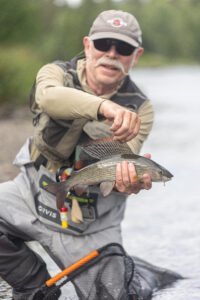
Grayling (Thymallus Thymallus) Photo credit: Devond Gulick
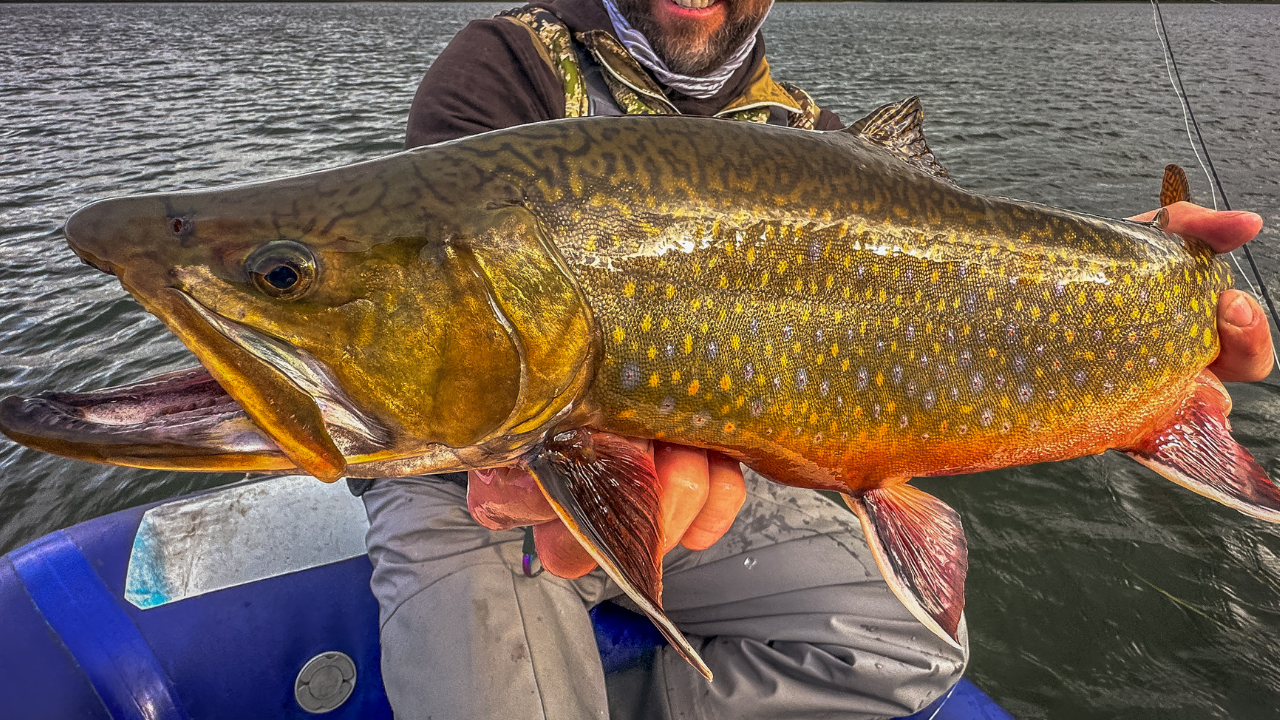
The Arctic Char, known as the “Greta Garbo of the mountains” due to its beauty, elusiveness, and air of mystery, is found in the high mountains in Sweden. They are extremely adaptable fish, and will diversify throughout an ecosystem, so some are voracious fish eaters, while others prefer insects, plankton, or snails.
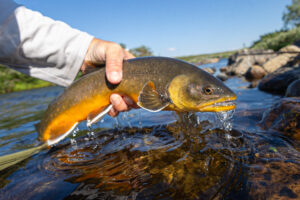
Arctic Char (Salvelinus alpinus) Photo credit: Devon Gulick
In Sweden they can grow quite large, up to around 11lbs, though the record is almost 24 lbs. The brown trout here in Sweden typically don’t range as far into the mountains as the arctic char, but since they can tolerate warmer waters, the distribution is changing. As the sun reaches its lowest point for the day, the large brown trout move into the deeper runs in the rivers, often evidenced by a lack of grayling in a likely looking spot. It is not uncommon to catch brown trout in the 10-15lb range, but requires patience and skill. Out on the lakes, the Northern Pike prowl the reed banks, ambushing other fish, frogs, ducks, mice, and anything else that moves. They reguarly grow to huge sizes, in the 15-30lb range, and are a blast to catch, especially on the fly.
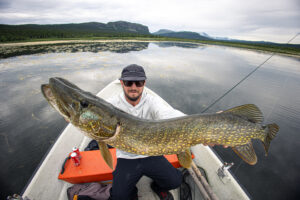
Northern Pike on the fly – Photo credit: Devon Gulick
We run our Got Fishing Hosted trip at the end of July every year, and while we are a month off the summer solstice, one can tie knots in 5x tippet at midnight. This time of year the water levels are usually at a good level, as the heavy snow-melt runoff has mostly subsided. While we are at roughly the same latitude as Utqiaġvik (formerly known as Barrow, Alaska), Swedish Lapland has a much milder climate, thanks to the warm Gulf Stream.
The long days mean lots of opportunities to fish, and it is not uncommon to fish from early in the morning to late at night with only breaks for meals. The beauty of nearly 24 daylight that most people fail to grasp who have not experienced it, is that we are freed from a circadian schedule and the result is a deep and pervasive relaxation. Yes, you could (like some of our fishing-obsessed guests), begin fishing at 3am when you get up to pee in the middle of the “night” and see rises, and not hang up your rod until after midnight. But you can also opt to sleep in and sip your coffee by the river, or take a midday nap when the desire hits, and know that you can still fish for hours upon hours and not miss out on the day. For the obsessed anglers this translates into tons of fishing, and for others it means enjoying the experience when the conditions are good and picking the best moments (and also lots of fishing). If it happens to be raining in the morning when we wake up, we can have leisurely breakfast (maybe some plätter-Swedish pancakes, with lingonberries) and another cup of coffee while we chat and wait for the weather to change, and we can still easily fish for 9-12 hours or more.
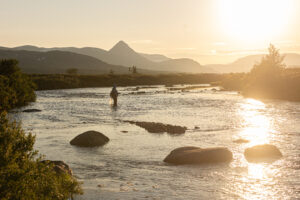
The end of the day…or beginning of the next? Photo credit: Devon Gulick
The Sauna is an extremely important part of Scandinavian culture. Many of my Swedish friends here have built a sauna in any place they spend any amount of time (their house, any cabins they might have, even floating on a lake!). They are often by a body of water and mostly wood-fired (we are far from any electricity). The wood stoves in the sauna have a water jacket that you fill with cold water when you start the fire and a spigot at the bottom allows you to mix the boiling hot water with a big bucket of cold water to get an optimal temp for a nice bucket shower. Even in the middle of winter you can get toasty warm and then take a hot bucket shower, complete with shampoo and conditioner.
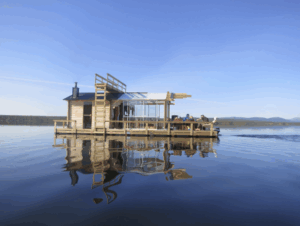 Lead guide Vidar’s floating Sauna
The Sauna’s floor has small gaps that allow the water to drain out, so you can be nice and warm while you take your shower. While most Swedes take their sauna naked, we typically wear bathing suits for everyone’s comfort. There is nothing quite like a ripping hot sauna with a cold beer at the end of a long day of fishing. The sauna often brings out an introspective mood and people find themselves sharing on a deeper level than when they aren’t profusely sweating and basking in the heat.
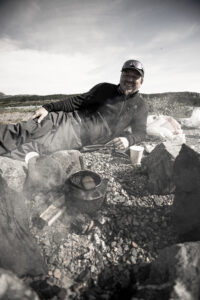
Vidar cooking coffee on the fire. When in doubt make coffee! Photo credit: Devon Gulick
This area of Sweden has very few people and we use helicopters to fly into remote cabins, where we are far from other anglers. The cabins have no WIFI, or electricity for that matter (besides a small solar panel for charging phones and radios). There are no nearby roads, hydropower dams, or any other human-made things making noise, other than the occasional helicopter transporting hikers. We hear the wind, the water, the birds, but the area is extremely peaceful and quiet. We are not fighting other anglers for a spot on the river, or reserving a beat. We are out in the vastness of the Swedish Lapland where the reindeer outnumber the people, the and the Sami people (the indigenous people of Northern Norway, Sweden, Finland and Russia) have been for thousands of years. In this remote landscape we still find small Sami settlements, often with the traditional turf “Goahti” (hut), returning to the landscape. Cabins have replaced most of the Goahti, but the Sami people are often still fishing in the lakes with nets. They hot smoke the Arctic char, as well as bake the flat, leavened bread called “Gahkko” that arrives warm and fluffy with a dusting of flour and a hearty, but slightly sweet, bite. During the trip we also smoke the Grayling, which, true to their Latin name Thymallus Thymallus, taste lightly of the herb Thyme, and have juicy white, flaky flesh. The Arctic Char and Brown trout are also delicious pan-fried over the fire in butter, poached in a white wine court bouillon, or even enjoyed raw as sashimi with a touch of wasabi and soy. But fish aren’t the only wild foods to be enjoyed in Swedish Lapland. Reindeer and moose are important food sources here and both are delicious. Reindeer is a deep, dark red, lean meat with a “wild” taste (not gamey). Souvas (salted and cold smoked reindeer) is sliced thin and sautéed with onions, wild mushrooms, finished with cream, and served with lingonberries and new potatoes. Moose is quite mild, and lighter in color than reindeer. It makes an appearance as the ever-popular moose burgers, but also as thick tenderloin steaks with a rich sauce and lots of black pepper.
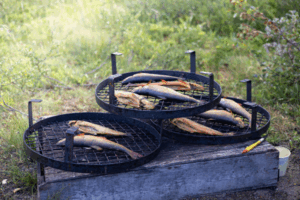
Freshly smoked Arctic Char Photo credit: Devon Gulick
Swedish Lapland during the summer becomes a carpet of berries; blueberries, bilberries, crow berries, lingonberries and the “gold of the north,” the cloudberry. These delicious berries are a circumpolar boreal plant and are high in vitamin C and have a tart and sweet taste. Warmed with a bit of sugar and served with cream, they are a unique and amazing taste of the North.

Almost ripe cloudberry, the “gold of the North” Photo Credit: Brian Adams
While the heavily feeding fish, endless days, saunas, remoteness, and great food all contribute to an amazing experience, there is something else. It is subtle, and hard to put into words, but almost everyone who visits the Arctic feels something. Many of our guests on these trips have come back, despite a plethora of other fishing opportunities to other locations. I don’t solely attribute that to the fishing, but rather to the effect the Arctic has on people, and you have to experience it to understand it. The biologist and writer Barry Lopez spent extensive time in the Canadian Arctic and his eloquent words begin to get at some reality of the Arctic:
“The land is like poetry: it is inexplicably coherent, it is transcendent in its meaning, and it has the power to elevate a consideration of human life.” ~ Barry Lopez, author of Arctic Dreams.
Join Got Fishing and Saveur the Journey July 22-30, 2026 for “Fly Fishing Under the Midnight Sun” in Swedish Lapland.
Aaron Schorsch
Owner – Saveur the Journey
Aaron Schorsch is the owner of Saveur the Journey where he combines his passions of food, travel, outdoor adventures, and culture. He grew up in rural New Hampshire and has lived and traveled extensively in the US and abroad. Aaron learned to fish for smallmouth and trout while growing up in rural New Hampshire. Later in life he found the joys of fly fishing, learning to sight cast for rising Arctic Char while living in Swedish Lapland. Aaron is a student of food who loves cooking over open fires, blending age old techniques with ones. He loves to talk about, think about, dream about, and especially, cook and eat food. He is a member of Slow Food International and has been a US delegate at Terra Madre in Turin, Italy. He currently lives in Jokkmokk Sweden, with his wife and two daughters.